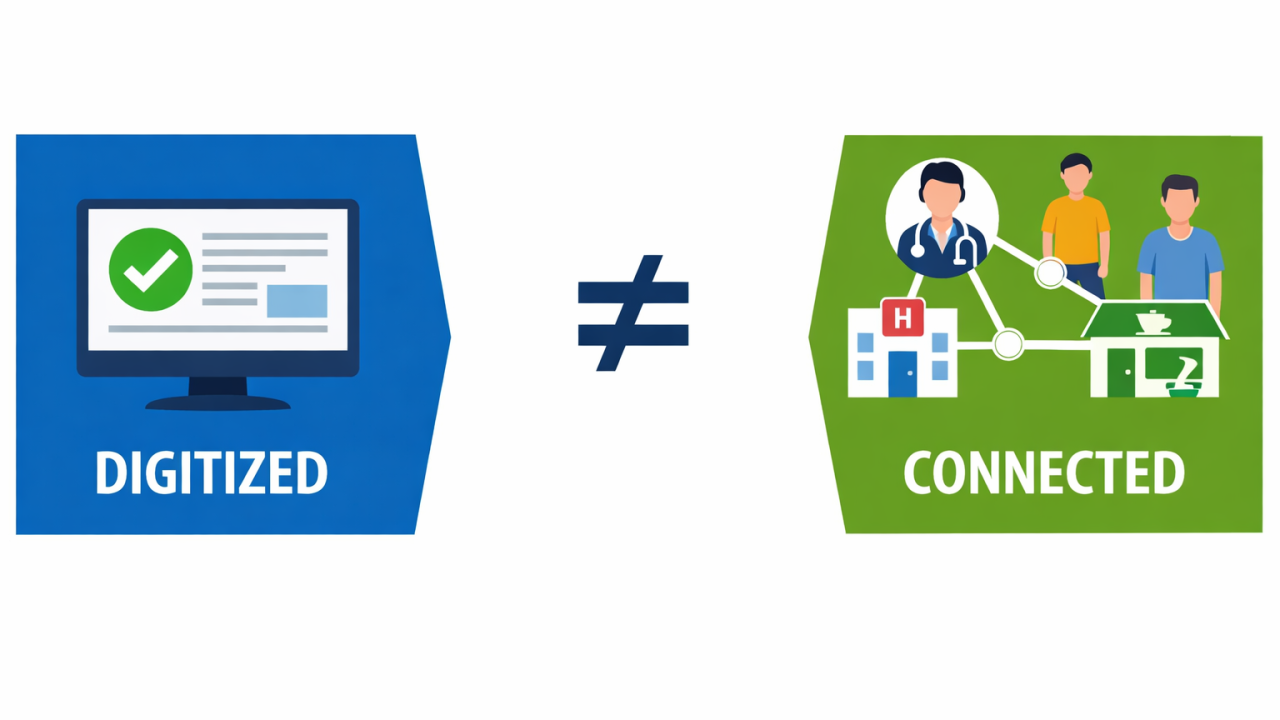

What Canada’s Connected Care Act (Bill S-5) Means for Digital Health
A breakdown of Canada’s push toward interoperable health data and what it means for healthcare leaders, systems, and patients.


Health Canada | Santé Canada introduced a federal Bill S-5, the Connected Care for Canadians Act, to the Parliament of Canada. The bill is presented as part of Canada’s plan to build a more connected health care system by enabling secure, interoperable digital health information sharing across the country.
This is an important moment for Canadian digital health. Fragmented health information has long complicated care coordination, limited access to personal health data, and hindered system planning and evaluation. Bill S-5 does not centralize health care delivery, nor does it create a national database. Instead, it seeks to create a legal and governance framework that makes connection possible and safer.
What the Connected Care for Canadians Act (Bill S-5) is proposing
Bill S-5 seeks to establish a federal framework focused on enabling digital health systems to connect more effectively and securely. The key objectives of the legislation include:
- Requiring information technology companies providing digital health services in Canada to adopt common standards to support protected and secure information exchange across systems.
- Empowering Canadians to access their own health information securely.
- Supporting improved sharing of information between patients, providers, and digital health platforms.
The bill is positioned as a step toward patient safety, better continuity of care, and alignment with international digital health interoperability standards.
Responsibility for health care delivery remains with provinces and territories. The federal role through Bill S-5 is intended to enable alignment and data exchange where jurisdictions agree to participate.
How this builds on earlier efforts to unblock health data
Bill S-5 builds on prior commitments to improve health data flow across Canada.
Public policy discussions, including the Pan-Canadian Health Data Charter and earlier digital health strategies, acknowledged that legal, technical, and governance barriers have long restricted seamless data sharing. Those initiatives highlighted the need to reduce data silos, enable interoperability, and improve patient access to information.
Another related legislative effort is Bill C-72, introduced in 2024, which also focused on interoperability and the prohibition of data blocking by health information technology vendors. Bill C-72 aimed to ensure that health IT allows secure access to and exchange of electronic health information.
Seen together, Bill S-5 represents a continuation and legislative step in a policy direction that has been developing over several years. It moves the focus from identifying barriers toward creating a structural framework that supports secure, interoperable digital health information exchange.
Why this matters for digital health
For digital health in Canada, Bill S-5 matters because it sets expectations rather than simply promoting technologies.
- Interoperability becomes a formal requirement. Interoperability is positioned as a foundation for digital health rather than an aspirational goal.
- Patient access to personal health data is reinforced. The bill explicitly empowers Canadians to access their own health information securely and consistently.
- Conditions for scaling digital health solutions improve. Common standards reduce duplication and friction when digital solutions are adopted across jurisdictions.
- Support for quality, planning, and innovation grows. With better information flow, health systems can more effectively monitor outcomes, plan resources, and support research.
Risks and constraints that remain
Bill S-5 provides a framework, not an instant fix.
Public trust is essential. Confidence depends on transparent rules for privacy, consent, and security.
Many organizations need investment in people, governance, and change capability to adopt new standards effectively.
Jurisdictional differences require collaboration rather than directive enforcement.
There is also a risk that digital inequities could widen if implementation does not include support for less mature regions and organizations.
What senior leaders should watch next
Senior leaders should monitor:
- How interoperability standards are developed and whether they align with real world implementation realities.
- Funding strategies that support operational readiness and workforce capability, not only technology acquisition.
- Privacy and consent models and how they are communicated to clinicians and the public.
- Mechanisms for federal-provincial-territorial collaboration to sustain alignment beyond legislation.
- Support for digitally less mature providers to reduce inequities in access and capability.
Execution will determine whether Bill S-5 leads to better continuity of care, safer transitions, and more efficient systems.
A measured and meaningful step
Bill S-5 reflects a clear acknowledgment that disconnected health information is no longer acceptable in a modern health system. It does not deliver immediate transformation.
What it does provide is a policy foundation that digital health efforts across Canada can align around. In advisory work with health system leaders, a consistent theme is that progress depends on clarity of roles, realistic sequencing, and sustained attention to governance and people, not only platforms.
If implementation is thoughtful, collaborative, and adequately resourced, this legislation has the potential to improve how care is delivered, experienced, and managed. Proceeding with a consistent focus on patients and providers will be essential.
References
- Government of Canada. The Government of Canada introduces legislation to build a more connected health care system. Health Canada News Release. February 4, 2026. https://www.canada.ca/en/health-canada/news/2026/02/the-government-of-canada-introduces-legislation-to-build-a-more-connected-health-care-system.html
- Canadian Nurses Association. CNA pleased with Government of Canada introduction of Connected Care for Canadians Act. February 4, 2026. https://www.cna-aiic.ca/en/blogs/cn-content/2026/02/04/cna-pleased-connected-care-for-canadians-act
- Parliament of Canada. Legisinfo: Bill S-5, Connected Care for Canadians Act. https://www.parl.ca/legisinfo/en/bill/45-1/s-5
- Parliament of Canada. Legisinfo: Bill C-72, An Act respecting the interoperability of health information technology and to prohibit data blocking by health information technology vendors. https://www.parl.ca/legisinfo/en/bill/44-1/c-72
Latest Insights