

Ontario just made a move on primary care records.
While this will likely be discussed as a technology initiative, the more important signal is about how primary care information is expected to function going forward.

This is not just a technology decision
Ontario has announced that it is moving toward a provincewide Primary Care Medical Record system. While this will likely be discussed as a technology initiative, the more important signal is about how primary care information is expected to function going forward.
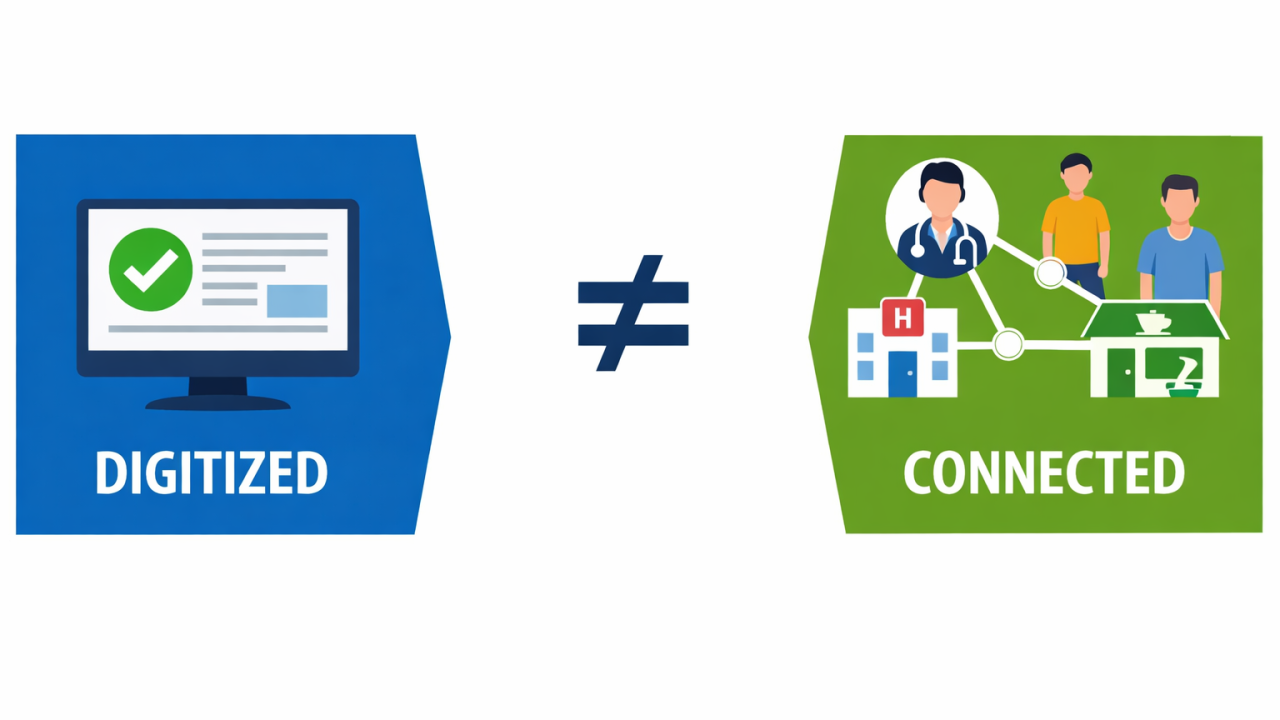
Digitization happened. Connectivity is the gap
Across Canada, primary care is already largely digital. Most clinicians use electronic medical records as part of their daily practice, and core activities such as documentation, prescribing, and ordering have been digitized over time. That transition, while significant, addressed only part of the problem.
The remaining challenge is how information moves.
Care is no longer confined to a single setting. Patients move between providers, providers work across teams and organizations, and care plans evolve over time. The information that supports those interactions does not always move with the same consistency or reliability. This shows up in repeated histories, delays in decision-making, and continued reliance on manual processes to bridge gaps between systems.
Ontario’s announcement should be understood in that context.
A shift from incremental to explicit direction
There has been ongoing work across Canada on interoperability and connected care, supported by national organizations and reinforced through recent federal legislation. Much of that work has progressed incrementally. Ontario’s move brings greater clarity by positioning connected primary care information as a provincewide objective.
This shifts the conversation. The question is no longer whether better information flow is needed. That is already well understood. The question is how it should be achieved.
Different paths, same underlying goal
There are multiple ways to approach this. A single system can provide consistency but introduces complexity in transition and adoption. A shared record model can enable access across settings while allowing different systems to remain in place. Strengthening interoperability across existing tools can also improve information flow when standards are clearly defined and applied.
Each approach can be viable. Each comes with trade-offs. What matters is whether information is available when and where it is needed to support care.
Keeping the focus where it matters
These conversations can quickly shift toward platforms, vendors, and architecture. Those decisions are important, but they are not the starting point. The starting point is the experience being created for patients and providers.
If a patient presents in a new setting, what information is available to the provider? If care is transferred, what information accompanies that transition? If multiple providers are involved, how is information kept consistent over time?
These are practical questions. They are also the ones that determine whether a system is working.
A national signal, not a provincial one
Ontario’s announcement establishes a clearer expectation that primary care information should be more connected, more accessible, and less dependent on where it was originally recorded.
That expectation is not limited to a single jurisdiction.
Across Canada, there is already a foundation to build on. Provinces and territories have implemented electronic health records, clinical viewers, and programs that support access to information across care settings. National work on interoperability continues to advance, and there is broad recognition that continuity of care depends on more than documentation within individual systems.
At the same time, this work is not complete. Differences in systems, workflows, governance, and policy environments continue to shape how information is shared and used.
What this means going forward
The takeaway is not that every jurisdiction should adopt the same approach.
It is that the direction is becoming clearer.
Primary care is increasingly distributed, collaborative, and longitudinal. The information that supports it needs to reflect that reality.
A useful question to keep in focus is whether information moves with care. If it does, the system is functioning as intended. If it does not, further change will be required, regardless of the model in place.
References
- Government of Ontario. Ontario Creating New Provincewide Primary Care Medical Record System. 2026.
- Government of Canada, Health Canada. Connected Care for Canadians Act – Announcement and Background. 2026.
- Canada Health Infoway. Shared pan-Canadian Interoperability Roadmap.
- Canadian Institute for Health Information. Health Providers Who Share Patient Health Information Electronically. 2024.
Latest Insights